|
|||||||||||||||
|
|
|||||||||||||||
 |
|
|
|
|
|
||||||||||


Project Keynet
Skill Needs of the target groups
 4.1
Skill needs defined by the education and training provider
4.1
Skill needs defined by the education and training provider
Formal system
4.1.1 Skill needs defined in secondary education
4.1.1a Skill needs defined in lower secondary school
With the exception of the subject "Informatics-Technology", skill needs are not specifically defined in the curriculum of the lower secondary school. The exception for this one subject may be attributed to the approach used for its instructional design (see concluding remark in section III) and to the adoption of a student-centered instructional method, which has proved very effective in developing key skills to students at this level.
According to the published curriculum for the "Informatics-Technology" subject (President's Decree, 1993) the following basic skills are to be developed using the methods of individual and team studies of some selected (by the pupils) technological concepts.
For the first gymnasium grade pupils work on individual projects and in the process they will develop the following skills: decision making on the selection of a feasible and interesting project; planning procedure, content and construction part of the project; retrieving, reviewing and classifying relative information; associating technological concepts to science principles; planning and executing the construction part of the project; reporting and orally presenting the project outcomes to his class; organizing together with his classmates an exhibition of the class projects to parents, teachers and other fellow pupils.
For the second gymnasium grade pupils work on team projects and in the process they will develop the following skills: collective decision making on the selection of the project; assigning and resuming responsibilities when dividing the tasks of the project; preparing a study visit to the industry selected for review; analyzing and structuring an industry according to its operational plan; identifying key roles in the context of an industrial administration plan; constructing a model of an industrial plant; drafting a team report to present the outcomes of the team project to interested parties, and conducting a team presentation of the outcomes of a project.
In summary, the instructional design of the technology subject in the lower secondary school promotes the development of the skill learning how to learn.
4.1.1b. Skill needs defined in upper secondary comprehensive lyceum
The scope of upper secondary general education is presented in the recent reform Law 2525/1997 and states: "The scope of the Comprehensive Lyceum is: a) providing high level general paedia; b) developing abilities, initiative, creativity and critical thinking; c) offering the necessary knowledge and provisions for continuing studies into the next education level, and d) developing skills which will facilitate access, following further specialization or training, to the labour market."
More specifically, in the framework of pupil assessment, the reform introduces the concept of "creative synthesis" projects, through which the pupils are to develop creative and synthesis skills.
Basic skills in upper secondary general education are generally and loosely defined in the national curricula developed by the Pedagogical Institute, in the framework of learning objectives and using such verbs as (for example for the subject of Physics): determine, graph, apply principles, measure physical quantities, use symbols, plan experiments, draw force diagrams, determine differences between, etc.
As in the case of lower secondary education, a best practice example of skill needs definition concerns a technology subject, which is required of all students in the first Comprehensive Lyceum Grade, and is titled "Technology: Research and Experimentation". The skill needs here are manifested in the form of "outcome objectives". For example in the Teacher Guide (Technology Teacher Guide) outcome objective No. 3 is stated as follows:
"The student analyzes the elements, which must be included in the description of the research problem".
Or in outcome objective No. 6: "The student states research hypotheses, which will be verified or rejected by the experimental findings, following the application of elementary statistical analysis principles".
4.1.1c Skill needs defined in upper secondary vocational school
In accordance with the "rationale report" submitted to Parliament together with the draft of Law 2640/1998, the scope of upper secondary vocational education is to "provide education, which concurrently develops knowledge, critical ability, skills and artistic appreciation. This education combines general education, broad specialized knowledge, vocational specialization in an extensive area of vocational activities, and in-depth studying of concepts, so that an independent vocational induction takes place under conditions of flexible employment and job security".
Basic skills in upper secondary vocational education are generally and loosely defined in the curricula developed by the Pedagogical Institute in the framework of learning objectives and using such verbs as: execute, specify, apply, recognize, describe, refer, estimate, compute, apply safety rules, operate, demonstrate, etc. However, the instructional method remains teacher-centered and teaching is limited to using the blackboard and the textbooks. This places many doubts on the learning outcomes for basic skills, which is supported by the findings of a recent survey of 1989 secondary education graduates. After they identified the most important basic skills for the performance of their job tasks (see Section V) they were in turn asked to what extent their school was successful in transmitting these skills to them. Their answers were not generally favorable (see Paleocrassas et al,1999).
4.1.2 Skill needs defined in post-secondary vocational training
Post secondary training is delivered in the public and private (proprietary) Institutes of Vocational Training (IEKs) and corresponds to the European training level IV. The graduates receive a Diploma (article 1, Dir. 92/51/EC), following a national certification procedure. The IEKs operate in the framework of the National System of Vocational Education and Training (Law 2009/1992) and interface with the education system as shown in Figure 3. The Organization for Vocational Education and Training (OEEK) supervises the National System for Vocational Education and Training and issues the training curricula, which are delivered at both public and private IEKs. It also regulates the professions which are accessible through secondary and post-secondary qualifications (European training levels I, II, III, and IV).
Skill needs are defined in post-secondary vocational training in the "Training Regulations" issued by OEEK for each vocational course delivered in the IEKs.
Each Training Regulation starts with a profile of the profession, which in turn is analyzed into job duties. The job duties are further analyzed into job tasks. The outcome of this task analysis is transformed into learning objectives, which lead in turn to the training curriculum. Skill needs identification is easily accomplished from such a detailed analysis by sorting out the verbs used for the specification of the learning objectives. For example, in the Training Regulation for the course "Surgery room nursing" (Training Regulation No. 104), following a synoptic professional profile there is a highly analytical description of skill objectives classified as "independent" nursing activities, "dependent" (under supervision by a physician) nursing activities, emergency activities, self-protection health skills, selection-furnishing-sorting-use-care-checking of necessary materials, book and file updating and surgery support skills.
Non-formal system
4.1.3 Skill needs defined in retraining older long-term unemployed
The Manpower Employment Organization (OAED) supervises a national network of Training Centres (KETEK), which deliver formal initial training courses (apprenticeship) and non-formal continuing training courses, which include accelerated retraining courses for long term unemployed.
Accelerated training programs for long term unemployed are targeted to vocations, which have been documented as occupations in demand by local surveys conducted by OAED. They are usually delivered in 600 contact hours and are very job specific. They are designed on the basis of specific skill needs, which are defined in the context of jobs unfamiliar to the unemployed taking part in the training and thus they constitute initial training courses. For example, in a training course for "surface painters" one identifies in the curriculum components which aim to develop skills such as calculating areas of surfaces, selecting materials, mixing paints, surface preparation and applying painting techniques, and applying safety rules. In a more ambitious retraining program for long term unemployed with a higher educational background, i.e. "computer-based sales", one may identify in the curriculum such skills as applying sales techniques, exercising public relations, using negotiation techniques, applying basic marketing techniques, basic computer skills, consumer communication skills.
4.2 Skill need defined by target Group
4.2.1 Skill needs defined by school dropouts (self-perception)
In 1995, in the context of a national survey of secondary education school dropouts (Paleocrassas et al, 1996), a sample of 1400 young people who had left compulsory school prematurely were located and interviewed in order to collect qualitative data on school dropouts. The interview included questions leading to the identification of their training needs. This constituted a major survey objective set by OEEK, which was the commissioning institution. OEEK was interested to design and deliver special training courses for these youngsters, on the basis of identified skill needs. The average age of the young people who were interviewed was 16 years old and the most frequent reason given for dropping out (74%) was school failure. Their most serious learning difficulties were in Mathematics, Science and Foreign Language. The majority held jobs after leaving school, mainly in low skill, low paying occupations in such fields as construction, agriculture, automobile maintenance and other services. Their self perception as workers was fairly low because of the level of their employment (assistant laborers) and their deficient educational background, which did not include any employable skills. Their skill needs were not identified in detail. Nevertheless, they were manifested in their stated interest to be trained for specific occupations and jobs, such as hairdresser, auto mechanic, dressmaker, carpenter, plumber. However, all of these occupations are accessible in Greece through formal qualifications, which are acquired with education and training courses corresponding to European training levels II and III. These courses are available only to compulsory education certificate holders.
4.2.2 Skill needs defined by secondary education graduates in the labour market
A recent national survey of secondary education graduates was conducted by the Pedagogical Institute (Paleocrassas et al, 1999) and addressed a sample of 5000 young people (from the1989 graduates cohort), who were interviewed on issues relating to their employment status longitudinally since their graduation date. The sample was stratified for gender, type of school attended, geographical region (35 Prefectures) and vocational course. The interview was structured and the questionnaire included some questions on the importance of basic skills (including some key skills) for job tasks performed at the time of the interview. The specific questions were asked only of respondents who declared matched (studies-job) employment, which was found to be on the average the case for 15-32% of the respondents, depending on the type of school they attended and on the vocational course they completed. The questionnaire identified as basic skills the following: Basic vocational skills, ability to apply job safety rules, team skills, written expression, foreign language, oral ability, computer skills, ability to cost and manage job tasks, knowledge of work regulations and legislation, highly specialized job skills and applying vocational methods and techniques.
Their answers were classified according to the school type which they attended.
4.2.2a General Lyceum graduates
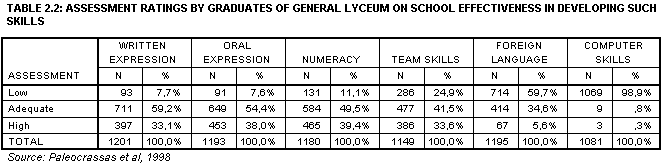
The General Lyceum (see old education-training context) was a conventional academic school, which constituted the main educational pathway towards higher education. Nevertheless, it is estimated that at least one out of four of its graduates end up in the labour market, either because on their own choice they decided to exit the education system, or because they were not successful in the highly competitive tertiary education entrance exams. There was no vocational component whatsoever in the curriculum. The types of jobs they held were generally office or clerk jobs. Table 2.1 summarizes the importance (skill-job relevance) attributed to some key skills by General Lyceum graduates. Table 2.2 shows their assessment ratings on their school's effectiveness in transmitting these skills to them.
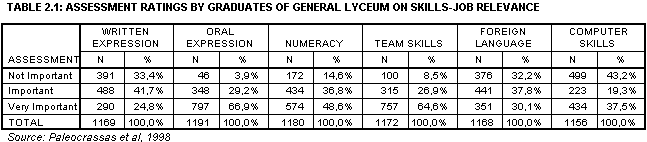
It is evident that
they rated highly the other skills (89.7%), which were declared
to be public relations and politeness, both being affective
skills and characteristic of jobs in the services sector. High ratings
were also received by oral ability (66.9%) and team skills
(64.6%). Low ratings were given to written expression (24.8%),
foreign language (30.1%) and computer skills (37.5%). On
the other hand, their assessment on the effectiveness of their school
in transmitting to them these skills does not seem generally favorable.
4.2.2b Technical-Vocational School graduates
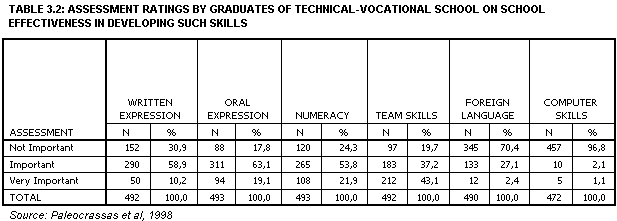
This school is the most occupation specific vocational school (see old education-training context) and it delivered both, school-based training and alternance training (apprenticeship). The study surveyed only graduates of the former type who held vocational qualification at the European training level II (skilled work). The jobs they held generally involved manual activities. Tables 3.1 and 3.2 display assessment ratings by graduates of Technical-Vocational Schools on skill-job relevancy and on school effectiveness, respectively.
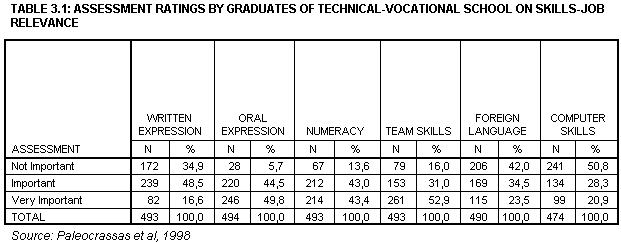
As it can be seen they
rated highly Basic vocational skills (79.4%), specialized vocational
methods and techniques (70.3%) and applying safety rules (74.9%).
On the other hand they gave low ratings to written expression (16.6%),
computer skills (20.9%) and foreign language (23.5%).
4.2.2c Integrated Multivalent Lyceum graduates
The Integrated Lyceum (see old education-training context) could be classified as a medium occupation specific school, because of its dual scope (prepare students for both, the labour market and for higher education). The graduates who were interviewed had a third year leaving certificate, i.e. they had not completed the highly occupation specific fourth year. Tables 4.1 and 4.2 show their assessment ratings on skill-job relevance and school effectiveness, respectively.
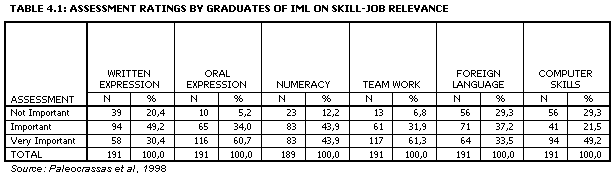
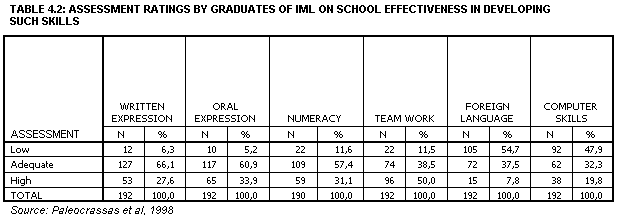
They rated highly team
work ( 61.3%), basic vocational skills (61.3%), oral
ability (60.7%) and highly specialized job skills (56.8%).
Their lowest ratings were for applying safety rules (27.1%) and
written expression (30.4%). The remaining skills were given
ratings somewhere in the middle. Needless to say that their answers were
influenced by the type of occupation they had, which in this case were
not highly skilled jobs.
4.2.2d Technical-Vocational Lyceum graduates
The Technical-Vocational Lyceum (see old education-training context) attracted mostly young people who wanted primarily to acquire vocational qualification at the European training level III and have the option upon graduation to enter the Technological Education system (Tertiary non-university system) by following a less competitive (through a quota) entrance path. The survey interviewed those who did not take this option but rather found skilled jobs with less manual activity than the corresponding for the Technical-Vocational School graduates.
Tables 5.1 and 5.2 display assessment ratings by the Technical-Vocational graduates on skill-job relevance and on their school effectiveness, respectively.
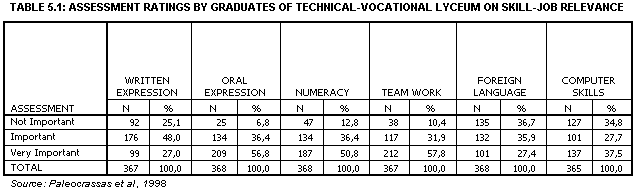

They rated highly basic
vocational skills (64.2%), specialized vocational methods and techniques
(60.8%), team skills (57.8%) and applying safety rules (54%).
Low ratings were given for written expression (27%) and foreign
language (27.4%).
With the exception of their high rating for team skills their ratings are almost identical with the ratings of the graduates of the lower training level Technical-Vocational School.
4.3 Skill needs defined by the certification system
The only competence-based certification system applied in Greece is implemented by the Organization for Vocational Education and Training (OEEK) for graduates of post-secondary vocational training institutes (IEKs). Skills for certification requirements are defined in the "Training Regulation" published separately for each training course, in the framework of stated learning theoretical and practical objectives. These skills are certified through annual national external written examinations for each vocation, for the case of the theoretical skills, and through regional oral examinations before three examiners (representing the social partners) inside a laboratory or workshop, for the case of the practical skills. Graduates of IEKs may sit these examinations as many times as they need until they are successful.
In the framework of the recent reform of technical-vocational education, a certification scheme will apply as well for secondary vocational education graduates. It will be implemented through regional final examinations on four basic subjects for the graduates of the first TEE cycle (see diagram for new articulation system), and through national final examinations on all subjects for the graduates of the second TEE cycle. Since these examinations have not as yet been applied it is difficult to assess to what extent they will effectively certify basic skills. Nevertheless, judging from previous experience acquired mainly from the post-secondary certification scheme, we anticipate that it will end up certifying mostly vocational knowledge.
In summary, it may be concluded that key skills are not being specifically assessed by the existing certification system for post secondary vocational training, and there is no indication so far in the design of the secondary vocational education system that there will be provision for certifying such skills separately from the conventional cognitive assessment.
4.4 Skill needs defined by employers
There are no mechanisms which systematically map the labour market for the identification of skill needs, as specified by employers. The Foundation for Economic and Industrial Research (IOBE) sporadically reviews the product of the vocational education system, when commissioned to do so by the employers union (SEB), but seldom these reviews become analytical and specific in defining skill needs. However, this deficit will soon be covered by special research activities conducted in two research institutions. The National Observatorium of Employment and the Observatorium of Transition from School to Work at the Pedagogical Institute. The former institution is supervised by the Manpower Employment Organization (OAED) and plans to incorporate skill needs identification in a jobs forecast research project. The latter plans skill needs identification through Ad Hoc committees of employers.


|
|
||
| Produced
by: UK: WJEC, NREC Germany: BILSE (Institute for Education and Research), Economic Development Company Greece: PRISMA Sweden: Swedish University Agricultural Department, Hogsby Municipality, Sweden |
||
 |
Project carried out with the support of the European Community within the framework of the Leonardo da Vinci Programme. This document does not necessarily represent the Commission's official position. |
|