Sweden Germany
U.K. Greece
Click on the relevant flag for information.


Log in to the
private project server
as a KeyNet Partner

Assessment Guide

Annexe 7

Examples of National Testing (UK)


LEVELS 3 AND 4

At Levels 3 and 4, the tests will comprise structured questions, or open-ended questions and will require more extended responses, thereby allowing you to demonstrate capability and confidence in each Key Skill. The questions will cover the selection and application of the knowledge, skills and understanding associated with each Key Skill.

The external assessment will include a combination of short response and extended response questions, each carrying around 25 marks to give a total of 50 marks. Questions will be based around a number of themes and may require you to refer to source material accompanying the test paper; you will not be required to carry out preparatory work. Resource material booklets and answer booklets will be provided with the tests.

Each test will be scheduled to last 1 hour and 30 minutes; electronic calculators are permitted for Application of Number; help files, grammar and spell checks can be used for IT as long as they are manually accessed by you and not accessed by automated routines.

Examples of Tests at Level 3 are given below.

COMMUNICATION - LEVEL 3

Time allowed 1 hour 30 minutes, including reading time.

There are two parts to the examination:

Part 1: Short answer questions
Part 2: Extended answer questions

You need to read the resource documents on the following three pages.

Part 1: Short Answer Questions
Refer to both documents when answering the questions.

1. Suggest six pieces of evidence from the document that women are discriminated against in the workplace.
    [7 marks]

2. Using your own words, list obstacles women face when working or trying to gain promotion. [5 marks]

3. What does the writer of Document 2 think of equality and Equal Opportunities legislation? Compare her views to
    those of the author of Document 1 (commenting also on how tone, vocabulary and style of writing are used to
    convey those views). [8 marks]

4. In your own words, summarise the views of the two writers on how discrimination against women can be resolved.
    [5 marks]


Part 2: Extended Answer Question

5. Write a detailed response to the author of DOCUMENT 2 explaining why you either agree or disagree with the
    views put forward in her article. You may include information from Documents 1 and 2 in your answer. You should
    write about 150-200 words. [25 marks]

DOCUMENT 1

Majority trapped by glass ceiling

Despite laws to prevent discrimination against women, they still have raw deal within a system dominated by men.

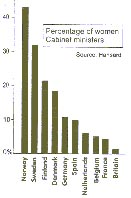
THERE are more British women than men: 51% of the population is female. This is because women live on average 6 years longer than men and boys are more likely to die at birth than girls. Although women form a majority of the population, they make up a minority of Britain's decision makers. Under 7% of members of parliament and only 0.5% of directors of private companies are women.
    The position of women in society has changed a great deal since 1900. Before World War II only a third of the workforce was female and women were expected to stay at home. Because of the war, from 1941 women aged 20-30 without children were required to work in factories and services to replace men who had left to join the armed forces. At the end of the war women were encouraged to give up their jobs to make way for the men returning from war. Since the 1960s, however, the number of working women has increased. By 2001 women will make up an estimated 45% of the workforce.

   But men continue to hold the most highly-paid and influential positions in government and industry. Over 70% of working women hold the lowest-paid jobs. Only 10% of senior managers are female.
    One report concluded that "for too man women there is a glass ceiling over their aspirations - it allows them to see where they might go, but stops them getting there".
    For more than 20 years, successive governments have tried to prevent sex discrimination (e.g. Equal Pay Act 1970 established equal pay for the same work). Nevertheless, many women are still paid 25-40% less than men doing equivalent work.
    Some jobs are not open to women at all. Women cannot hold certain positions within the armed forces, for example.
    According to the Equal Opportunities Commission (EOC), hidden barriers prevent women from securing top jobs. Some employers still believe women are less capable of making decisions. This is not borne out by the facts. At all levels of education women perform well, and some better at GCSE and, at university, obtain as many 1st class degrees as men.
    But women face an even greater hurdle than employers; they also perform most of the work involved in caring for children and for older and disabled people. Most of Britain's carers are women - the "invisible" work force because it is largely unpaid and doesn't appear on economic records.


Parliament itself is one example of the difficulties women face in combining family commitments and paid work. Since women got the vote in 1918 and until the election this year (1997), only 140 or so had become MPs. This was partly because few women were selected as candidates. But it was also because politicians' working hours conflict with family life.
    "Late hours deter women from seeking entry into Parliament", said one woman MP. "This makes the House of Commons profoundly unrepresentative of a nation composed of almost 52% women".
    Of course, the election of so many Labour Party women MPs has changed all this quite dramatically. Perhaps, even in politics, gender is becoming less of an issue.

The Struggle to Survive

Long hours of hard work are a necessity for many women, especially in the developing world.

In many countries in Africa and Asia women are the main farmers: they till the land, sow the seeds and tend the crops. They also perform most of the housework.
    Aid charities say that women form an essential, but largely ignored, part of the economy of developing countries. Studies suggest that often the work undertaken by women is harder than that done by men and involves working longer hours than they do. A study in Tanzania, for example, showed that women work 3,069 hours per year compared with 1,829 for men.
    According to the United Nations women grow more than half the food produced in developing countries: over 80% for sub-Saharan Africa. Women collect most of the water needed for families and crops.
    In some families, women are in charge of all the farming work because the men have migrated to the towns in search of paid jobs. A third of all rural households in developing countries are headed by women.
    A study by Oxfam in Nepal found that females tend to perform more work than males from an early age. Girls rarely go to school because they have to look after younger brothers and sisters or help their mother. As a result, as few as 18% of all Nepalese women can read compared with 52% of boys.
    There is a growing trend also for females to migrate to towns in search of factory work. Clothing factories in the Philippines, for example, employ 90% female labour. Most women work for just 2 or 3 years in the factories partly because the work is so wearing.
    Other women in towns earn their living on the "informal market". This means they have no regular paid work but make ends meet selling goods on the street or doing odd jobs.
    Feminism, the fight for women's rights, is often seen as a western ideology which is a luxury for poor women in developing countries.

Family

Women with young children tend to take a break from work or work part-tine. But having children does not affect the working patterns of men so dramatically.

Only 8% of mothers with children aged 0-4 years are in full-time work and 2 1 % in part-time work.

83% of fathers with young children are in. full-timework and 1% in part-time work.


DOCUMENT 2

Based on 'The Whole Woman'
by Germaine Greer
(publishers - Doubleday 1999)

     The notion of equality takes the male status quo as the condition to which women aspire. Men live and work in a frighteningly unfree and tyrannical society, constructed upon the oppression of junior males by senior ones... As soon as a woman enters a male preserve, be it the police, or the military, the building site, the law, the clergy, she finds herself in an alien and repellent world which changes her fundamentally even as she struggles to exert the smallest influence on it. Aspirants to rank in such groups have to learn the ropes and then bounce their rivals on to them. The woman who becomes leader of a conventional political party can only do so because she has become tougher than the men in it. It was often said of Margaret Thatcher that, despite her frothy bows and four-inch heels, she was the only man in her cabinet.

     The Wilson government of 1975 that brought in the Sex Discrimination Act along with the Equal Opportunities Commission was made up of businessmen and lawyers. The Sex Discrimination Act was designed to give people the illusion that women's oppression had been recognised and that something was being done about it and, at the same time, to reassure that no great changes were likely to ensue and business would go on exactly as usual. There was never the remotest chance that employers would find themselves facing thousands of hours of lucrative work for lawyers as case after case was argued interminably only to be lost.

     For the young women who now outnumber young men graduating in law, life in chambers can be a nightmare of discrimination amounting to outright prosecution and harassment. A report by legal recruitment consultants Reynell, published in January 1997, found that a quarter of women solicitors have suffered harassment and almost half have been disadvantaged because of discrimination on grounds of sex. Yet women lawyers seldom bring cases under the Sex Discrimination Act. As lawyers they know better. In their struggle to build a career, even if the woman lawyers won their cases, they would lose their prospects.

      Every week brings new evidence of the struggles of women in male-dominated professions. The solution, some say, is to have equal numbers of women. This cannot be done because women will not be recruited in large numbers unless a policy of reverse discrimination is adopted. This cannot happen because it is illegal under the Sex Discrimination Act to allocate resources or jobs to women as it can be argued that this discriminated against men. Equality is cruel to women because it requires them to copy behaviours that they find profoundly alien and disturbing. If women can see no future beyond joining the masculine elite on its own terms, our civilisation will become more destructive than ever. Women. need liberation, not equality. They should be free to define their own values, order their own priorities and decide their own fate.


APPLICATION OF NUMBER - LEVEL 3

Time allowed 1 hour 30 minutes, including reading time.

There are two parts to the examination:

Part 1: Short answer questions
Part 2: Extended answer questions

Part 1 Short answer questions

EXAMPLES

1. Jess has to quickly work out an estimate of {specific equation given} in her head. Show a method she could use.
    Use it to give an estimate for the value of the calculation. [2 marks]

2. The population of Kenya has been increasing by 4.5% per year,
    (a) After how many years could you expect its population to have doubled? [2 marks]
    (b) Give two factors which could affect your forecast in part (a). [1 mark]

5. A store has a cafeteria that bakes its own cakes. The recipe for a fruitcake mixture is:

INGREDIENTS
PARTS BY WEIGHT
butter
3
sugar
3
flour
3
dried fruit
4
powdered egg
4
milk
2.75
salt
Trace
baking powder
0.25

(a) Find the actual weight in grams of flour and baking powder used for 3 kg of the cake mixture. [2 marks]

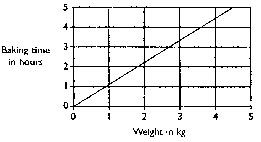
(b) The baking time for a cake depends on its weight and this is shown in a graph.

Estimate the baking time for the 3 kg cake. [1 mark]


Part 2: Extended Answer Question

People are becoming aware of possible connections between "Body Mass Index" and fitness. A person's Body Mass Index (BMI) gives a rough measure of how under- or over-weight the person might be.

Eleven people volunteered to take part in an experiment to measure their relative fitness and then compare the results with their BMI. The people were in two groups, group A and group B.

In the fitness test, each person relaxed for 10 minutes (to establish their resting pulse rate PR) and then undertook a specified number of step-ups over a four minute period. The person's pulse rate was measured immediately after finishing the step-ups (Po), and again after 6 minutes of rest (P6).

A person's fitness can be estimated by how quickly their heart rate recovers after a period of strenuous exercises measure of fitness, H, can be calculated using the formula.

{Specific equation given here}

The results are given in Table 1.

Table 1
Person
PR
beats/min
P0
beats/min
P6
Beats/min
Height
(m)
Weight
(kg)
H
Group A
G
86
144
88
1.62
46
0.97
H
90
134
97
1.57
64
0.84
J
76
129
77
1.74
78
0.98
K
82
146
83
1.79
73
0.98
L
75
135
79
1.76
82
0.93
Group B
M
72
100
76
1.58
48
N
78
95
78
1.64
54
P
68
120
80
1.78
54
Q
72
116
72
1.74
58
R
80
112
80
1.80
72
S
68
120
78
1.54
64


Table 2
Body Mass Index
ht/m
1.50
1.52
1.54
1.56
1.58
1.60
1.62
1.64
1.66
1.68
1.70
1.72
1.74
1.76
1.78
1.80
wt(kg)
40
18
17
17
16
16
16
15
15
15
14
14
14
13
13
13
12
42
19
18
18
17
17
16
16
16
15
15
15
14
14
14
13
13
44
20
19
19
18
18
17
17
16
16
16
15
15
15
14
14
14
46
20
20
19
19
18
18
18
17
17
16
16
16
15
15
15
14
48
21
21
20
20
19
19
18
18
17
17
17
16
16
15
15
15
50
22
22
21
21
20
20
19
19
18
18
17
17
17
16
16
15
52
23
23
22
21
21
20
20
19
19
18
18
18
17
17
16
16
54
24
23
23
22
22
21
21
20
20
19
19
18
18
17
17
17
56
25
24
24
23
22
22
21
21
20
20
19
19
18
18
18
17
58
26
25
24
24
23
23
22
22
21
21
20
20
19
19
18
18
60
27
26
25
25
24
23
23
22
22
21
21
20
20
19
19
19
62
28
27
26
25
25
24
24
23
22
22
21
21
20
20
20
19
64
28
28
27
26
26
25
24
24
23
23
22
22
21
21
20
20
66
29
29
28
27
26
26
25
25
24
23
23
22
22
21
21
20
68
30
29
29
28
27
27
26
25
25
24
24
23
22
22
21
21
70
31
30
30
29
28
27
27
26
25
25
24
24
23
23
22
22
72
32
31
30
30
29
28
27
27
26
26
25
24
24
23
23
22
74
33
32
31
30
30
29
28
28
27
26
26
25
24
24
23
23
76
34
33
32
31
30
30
29
28
28
27
26
26
25
25
24
23
78
35
34
33
32
31
30
30
29
28
28
27
26
26
25
25
24
80
36
35
34
33
32
31
30
30
29
28
28
27
26
26
25
25
82
36
35
35
34
33
32
31
30
30
29
28
28
27
26
26
25
84
37
36
35
35
34
33
32
31
30
30
29
28
28
27
27
26
86
38
37
36
35
34
34
33
32
31
30
30
29
28
28
27
27
88
39
38
37
36
35
34
34
33
32
31
30
30
29
28
28
27
90
40
39
38
37
36
35
34
33
33
32
31
30
30
29
28
28

a) Use the information in Table 1 to calculate the values for H for the member in group B (the values of H for group A     have already been calculated).

    Make it clear how you calculated at least one of the values of H. (4 marks)


b) Find the range of H values for each group.

    Choose, then find an appropriate average (mean, median or mode) for each of the two sets of values of H and
    give a reason for your choice.

    Show clearly one of your calculations of average. (5 marks)


c) Use your results from part a) and part b) to compare the levels of fitness of the two groups.

     Give at least two reasons to support your conclusions. (2 marks)


d) Using Table 2, find the Body Mass Index for each of the eleven volunteers.

     Present the values for H and BMI in a suitable table. (4 marks)


e) Present a suitable, clearly labelled graph showing H plotted against BMI for the eleven volunteers (plot BMI across
    the page and H upwards). (7 marks)


f) Describe any ways in which BMI and H appear to be related. Comment on the possibility of estimating an
    individual's H value from their Body Mass Index. (3 marks)


back | top | next


United Kingdom

WJEC
(Welsh Joint Education Committee)
Information
KeyNet Web-site

NREC
(National Rural Enterprise Centre)
Web-site

Produced by:
UK: WJEC, NREC
Germany: BILSE (Institute for Education and Research),
Economic Development Company
Greece: PRISMA
Sweden: Swedish University Agricultural Department,
Hogsby Municipality, Sweden

Project carried out with the support of the European Community within the framework of the Leonardo da Vinci Programme.

This document does not necessarily represent the Commission's official position.