|
|||||||||||||||
|
|
|||||||||||||||
 |
|
|
|
|
|
||||||||||


Annexes
Using the Examples in these Annexes
Examples of Questionnaires to show current level of achievement
Computer generated Questionnaire to show current level of achievement
An example of a formal written test based upon contextualised Tasks
Practical activities and written tests to assess IT competence
Examples of Portfolio and Logbook development
Practical, contextualised tests
Assessment targeting those with learning difficulties
Using the Examples in these Annexes
1. The 'Annexes' that follow contain examples of a range of assessment techniques that are used by trainers in their assessments of a student, trainee, or job seeker's achievement in a key skill. Whereas the earlier Examples in Sections 4-8 provided examples of general approaches to assessment - the 'when' of assessment), the examples here illustrate how the assessment takes place. The difference is illustrated in the diagram below.
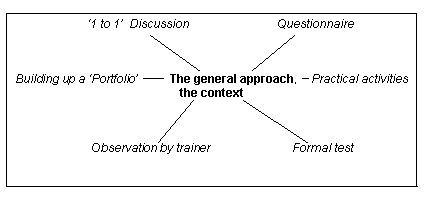
Decisions to be made by the trainer:
Step
1
Decide which of the Examples in Sections 4-8 are similar to the
context or situation of the trainer, e.g. a school, a training
provider working in a small workshop, a factory with a combination
of on-the-job and off-the-job training, a small enterprise (hairdresser).
This context is illustrated by the whole rectangle.
Step
2
Look through the techniques of assessment illustrated in these
Annexes. These are illustrated in italics in the diagram above,
e.g. the use of a portfolio. A formal test, or observation by
the trainer/employer.
2. Assessment tries to discover the individual's level of achievement, weaknesses and strengths by using the most appropriate assessment technique. As a result, the trainee can develop a programme specifically suited to the individual's needs.
3. Each Annex illustrates a technique, or number of techniques, that allow the trainer to discover this information in the most effective way, in a given context. Each technique may be used in the assessment of all three approaches to assessment, i.e. diagnostic, formative and summative.


|
WJEC NREC |
||
| Produced
by: UK: WJEC, NREC Germany: BILSE (Institute for Education and Research), Economic Development Company Greece: PRISMA Sweden: Swedish University Agricultural Department, Hogsby Municipality, Sweden |
||
 |
Project carried out with the support of the European Community within the framework of the Leonardo da Vinci Programme. This document does not necessarily represent the Commission's official position. |
|